

ГДЗ по английскому языку 9 класс Ваулина, Дули, Подоляко, Эванс - ответ страница 158

Авторы: Ваулина Ю.Е., Дули Д., Подоляко О.Е., Эванс В.
Серия: Spotlight
Тип книги: Учебник
Год: 2015-2025



 Премиум


Reading Task 2
Study skills
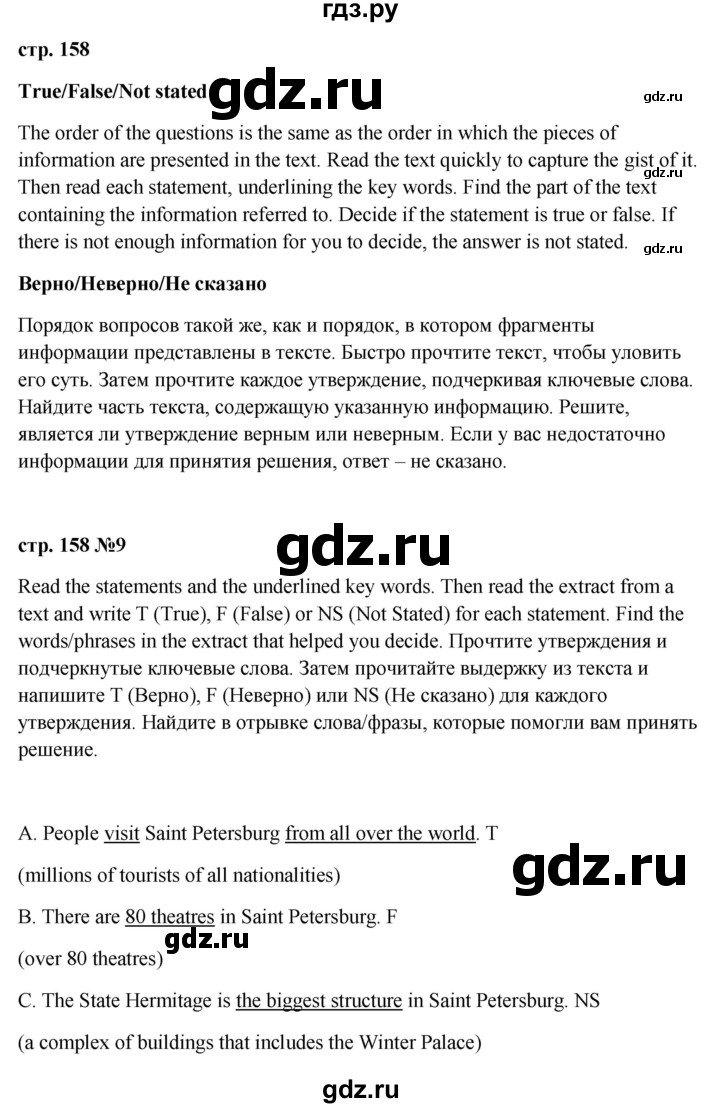
True/False/Not stated
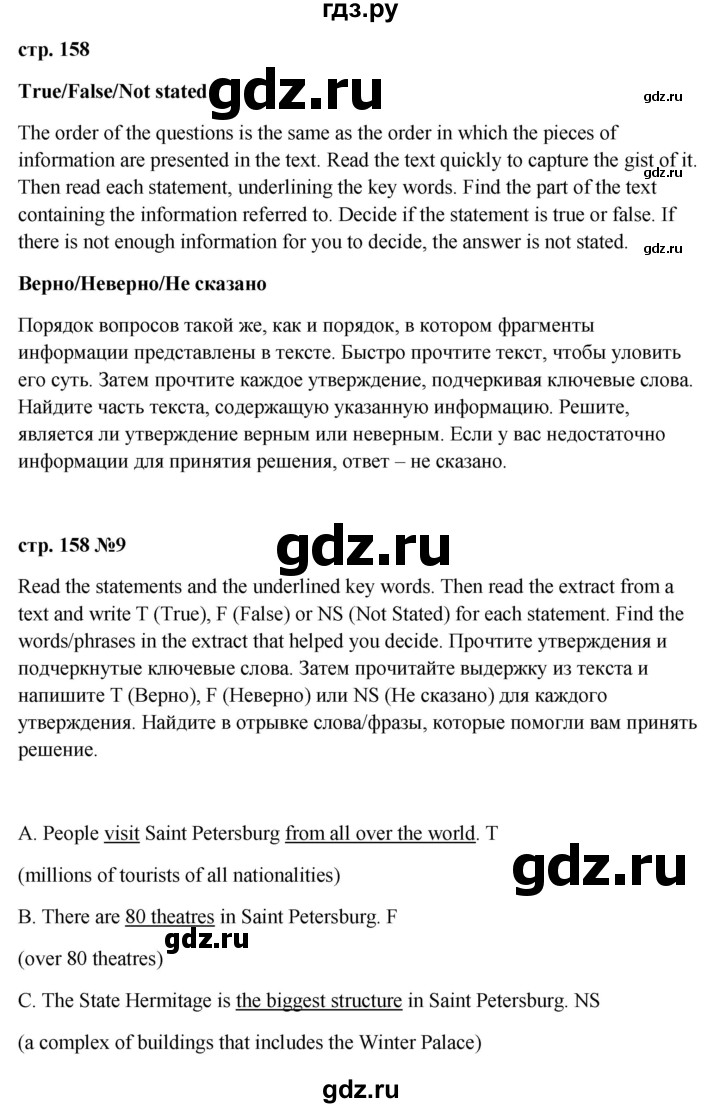
The order of the questions is the same as the order in which the pieces of information are presented in the text. Read the text quickly to capture the gist of it. Then read each statement, underlining the key words. Find the part of the text containing the information referred to. Decide if the statement is true or false. If there is not enough information for you to decide, the answer is not stated.
9. Read the statements and the underlined key words. Then read the extract from a text and write T (True), F (False) or A/S (Not Stated) for each statement. Find the words/phrases in the extract that helped you decide.
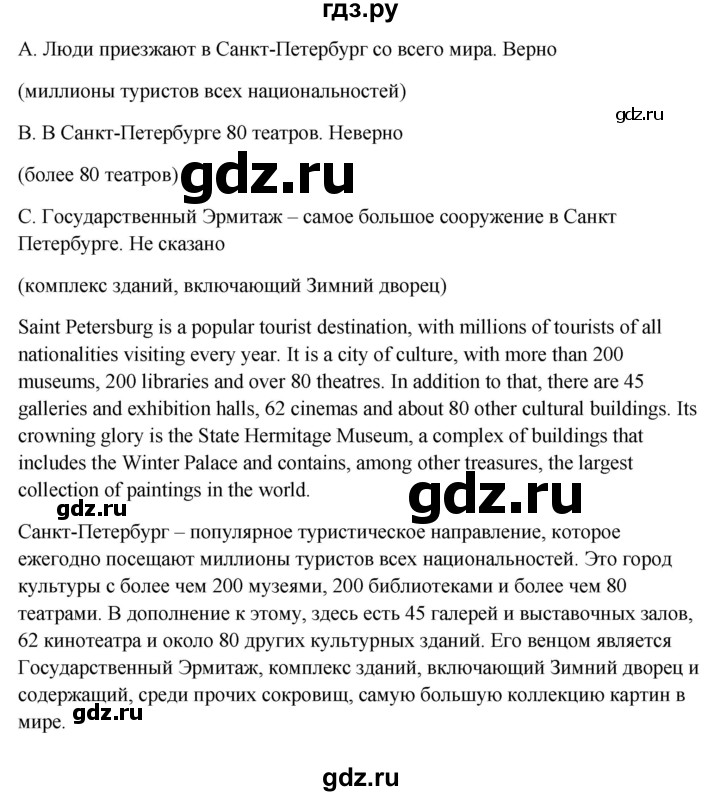
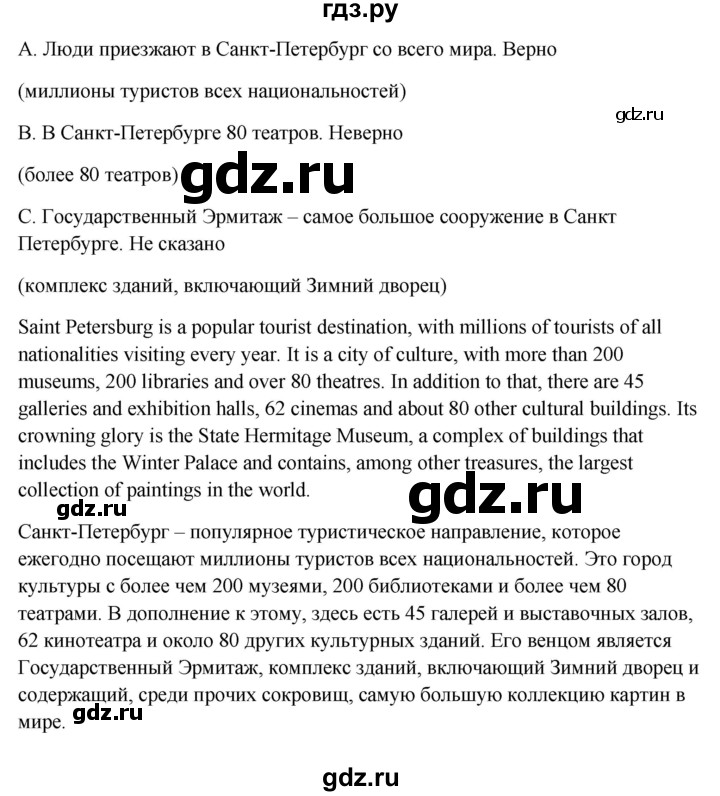
A People visit Saint Petersburg from all over the world.
B There are 80 theatres in Saint Petersburg.
C The State Hermitage is the biggest structure in Saint Petersburg.
Saint Petersburg is a popular tourist destination, with millions of tourists of all nationalities visiting every year. It is a city of culture, with more than 200 museums, 200 libraries and over 80 theatres. In addition to that, there are 45 galleries and exhibition halls, 62 cinemas and about 80 other cultural buildings. Its crowning glory is the State Hermitage Museum, a complex of buildings that includes the Winter Palace and contains, among other treasures, the largest collection of paintings in the world.
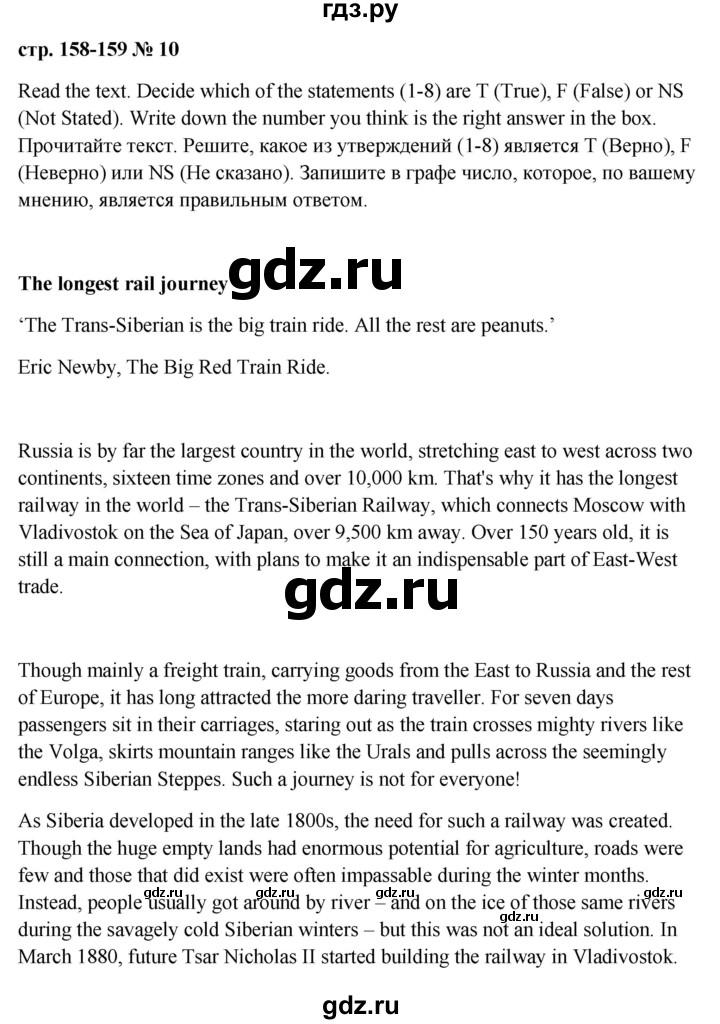
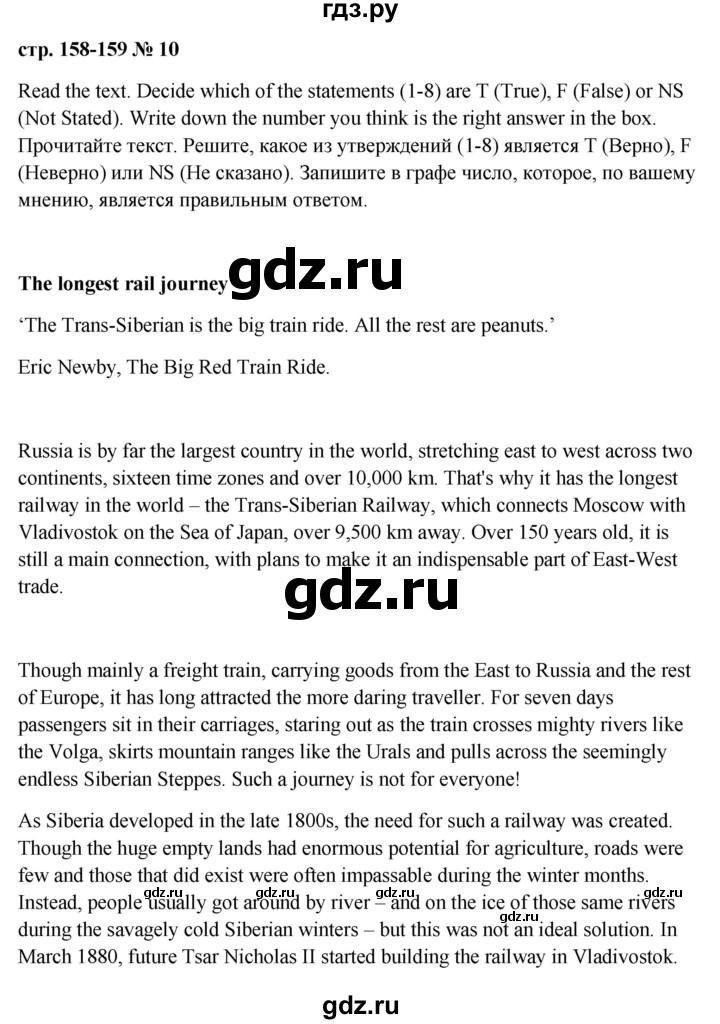
10. Read the text. Decide which of the statements (1-8) are T (True), F (False) or A/S (Not Stated). Write down the number you think is the right answer in the box.
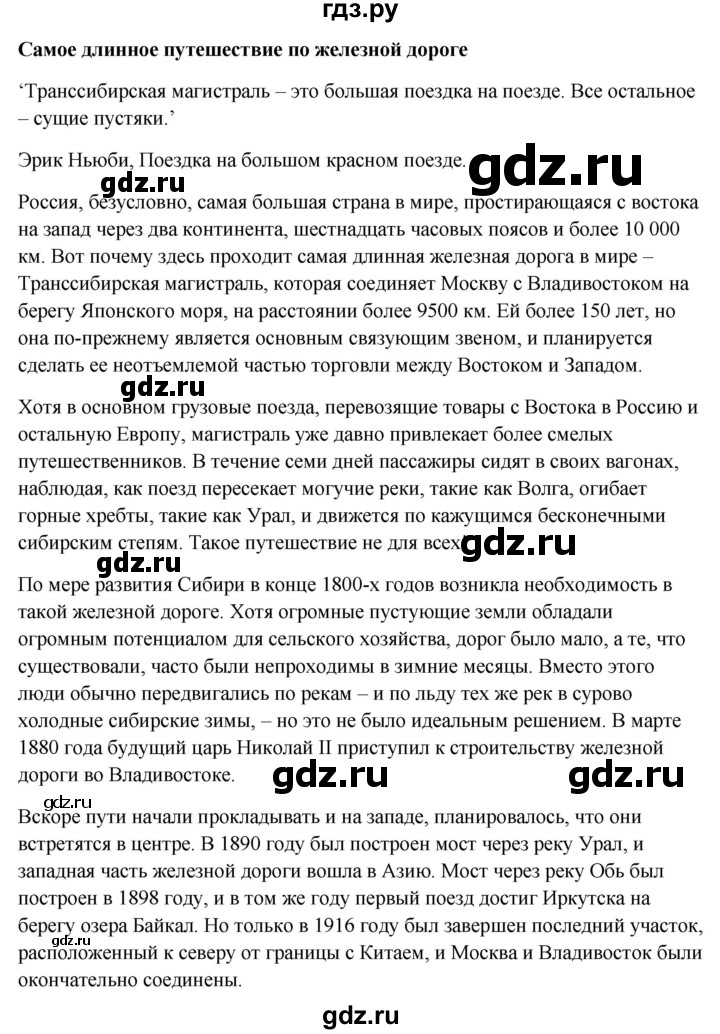
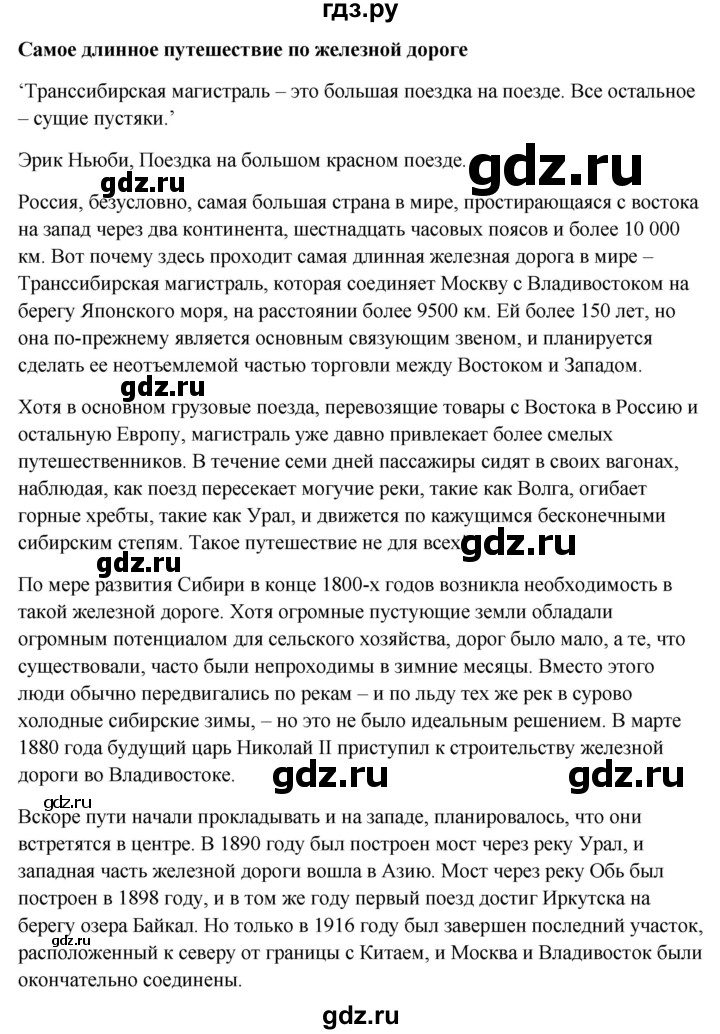
The longest rail journey
‘The Trans-Siberian is the big train ride. All the rest are peanuts' Eric Newby, The Big Red Train Ride.
Russia is by far the largest country in the world, stretching east to west across two continents, sixteen time zones and over 10,000 km. That's why it has the longest railway in the world - the Trans-Siberian Railway, which connects Moscow with Vladivostok on the Sea of Japan, over 9,500 km away. Over 150 years old, it is still a main connection, with plans to make it an indispensable part of East-West trade.
Though mainly a freight train, carrying goods from the East to Russia and the rest of Europe, it has long attracted the more daring traveller. For seven days
passengers sit in their carriages, staring out as the train crosses mighty rivers like the Volga, skirts mountain ranges like the Urals and pulls across the seemingly endless Siberian Steppes. Such a journey is not for everyone!
As Siberia developed in the late 1800s, the need for such a railway was created. Though the huge empty lands had enormous potential for agriculture, roads were few and those that did exist were often impassable during the winter months. Instead, people usually got around by river - and on the ice of those same rivers during the savagely cold Siberian winters - but this was not an ideal solution. In March 1880, future Tsar Nicholas II started building the railway in Vladivostok.
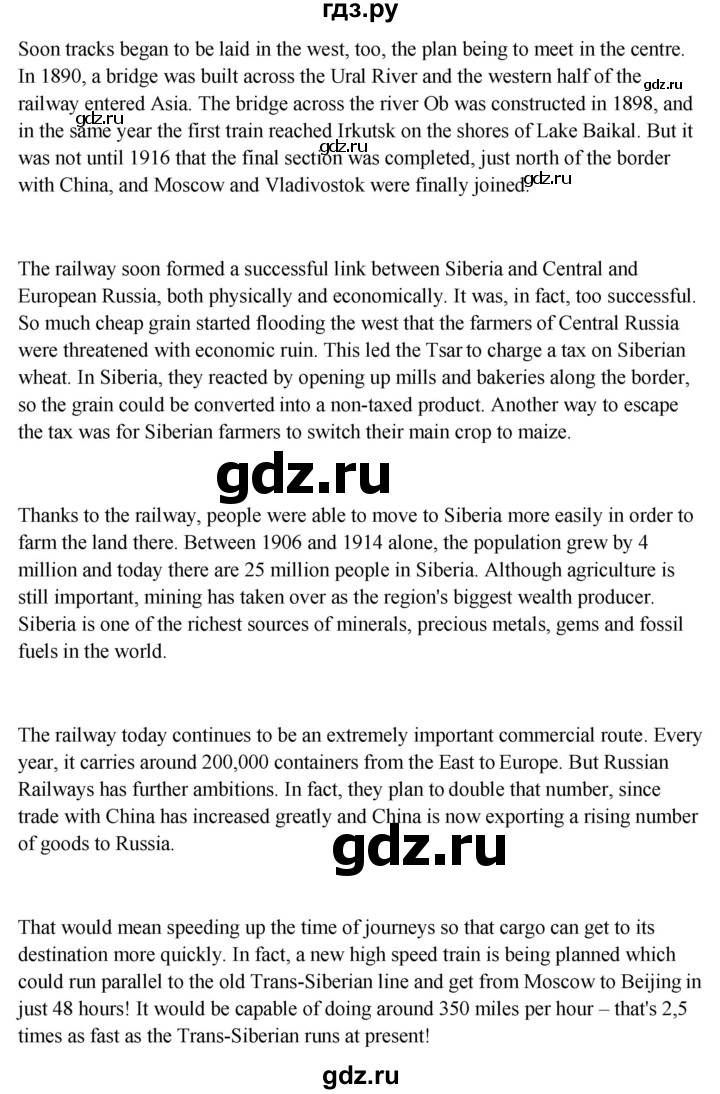
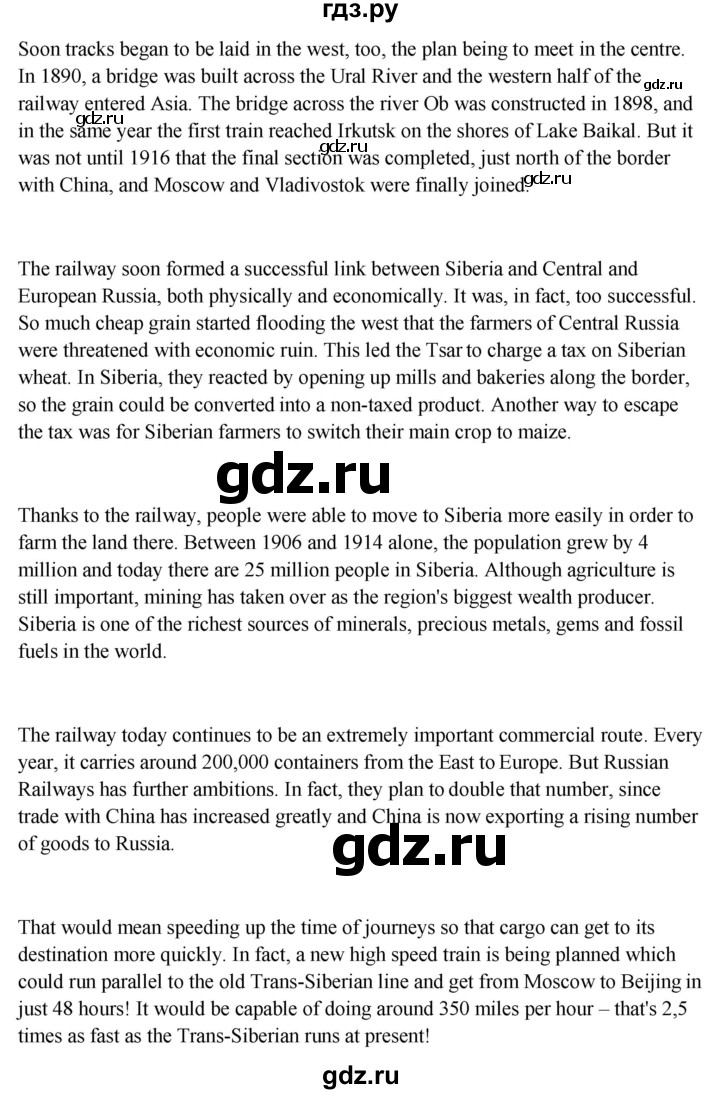
Soon tracks began to be laid in the west, too, the plan being to meet in the centre. In 1890, a bridge was built across the Ural River and the western half of the railway entered Asia. The bridge across the river Ob was constructed in 1898, and in the same year the first train reached Irkutsk on the shores of Lake Baikal. But it was not until 1916 that the final section was completed, just north of the border with China, and Moscow and Vladivostok were finally joined.
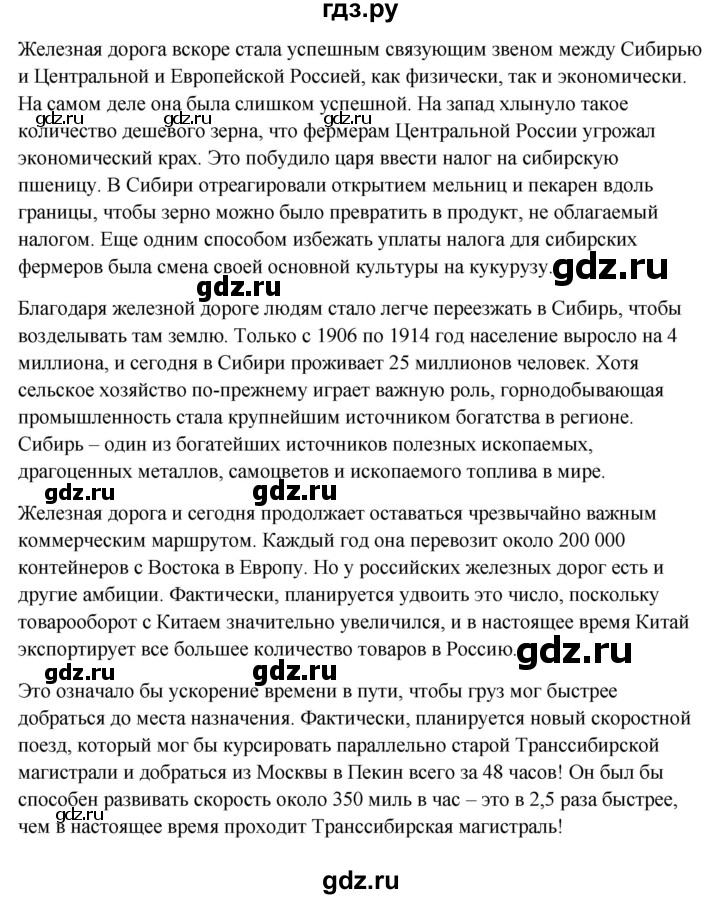
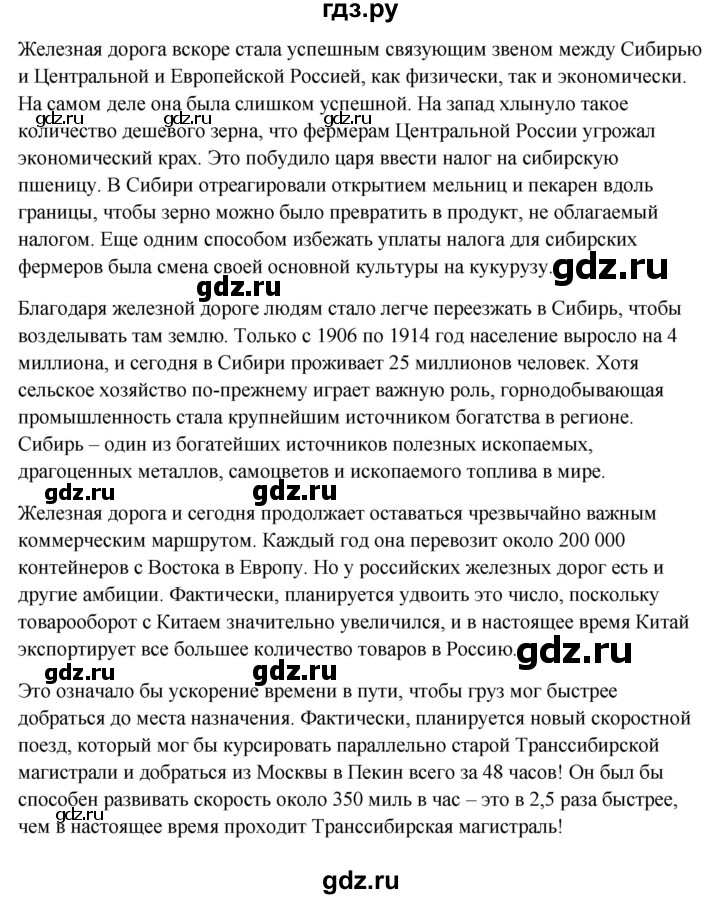
The railway soon formed a successful link between Siberia and Central and European Russia, both physically and economically. It was, in fact, too successful. So much cheap grain started flooding the west that the farmers of Central Russia were threatened with economic ruin. This led the Tsar to charge a tax on Siberian wheat. In Siberia, they reacted by opening up mills and bakeries along the border, so the grain could be converted into a non-taxed product. Another way to escape the tax was for Siberian farmers to switch their main crop to maize.
Thanks to the railway, people were able to move to Siberia more easily in order to farm the land there. Between 1906 and 1914 alone, the population grew by 4 million and today there are 25 million people in Siberia. Although agriculture is still important, mining has taken over as the region's biggest wealth producer. Siberia is one of the richest sources of minerals, precious metals, gems and fossil fuels in the world.
The railway today continues to be an extremely important commercial route. Every year, it carries around 200,000 containers from the East to Europe. But Russian Railways has further ambitions. In fact, they plan to double that number, since trade with China has increased greatly and China is now exporting a rising number of goods to Russia.
That would mean speeding up the time of journeys so that cargo can get to its destination more quickly. In fact, a new high speed train is being planned which could run parallel to the old Trans-Siberian line and get from Moscow to Beijing in just 48 hours! It would be capable of doing around 350 miles per hour - that's 2,5 times as fast as the Trans-Siberian runs at present!
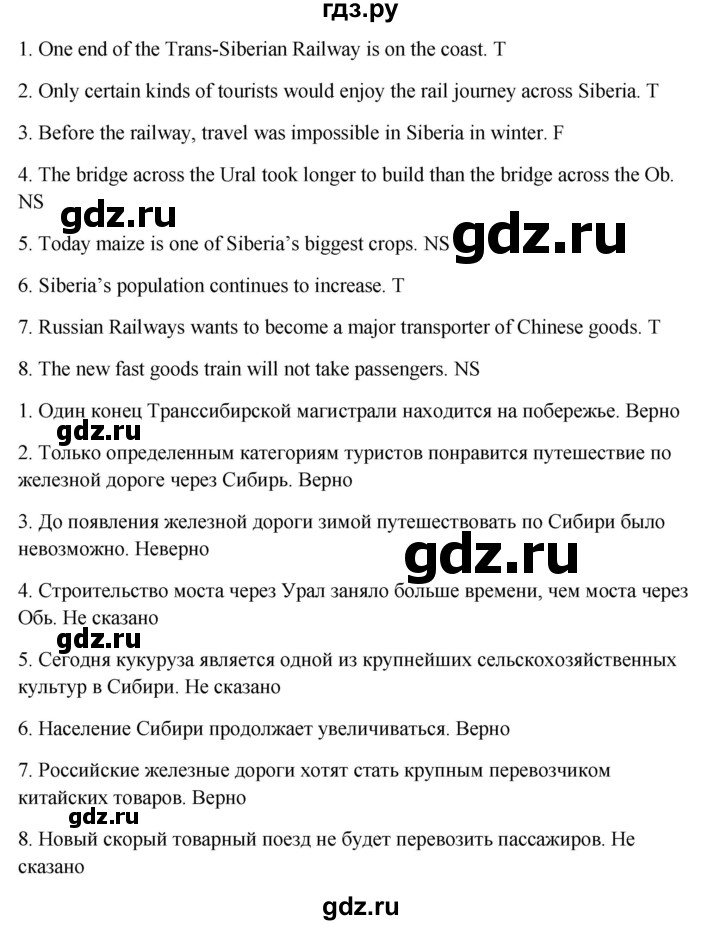
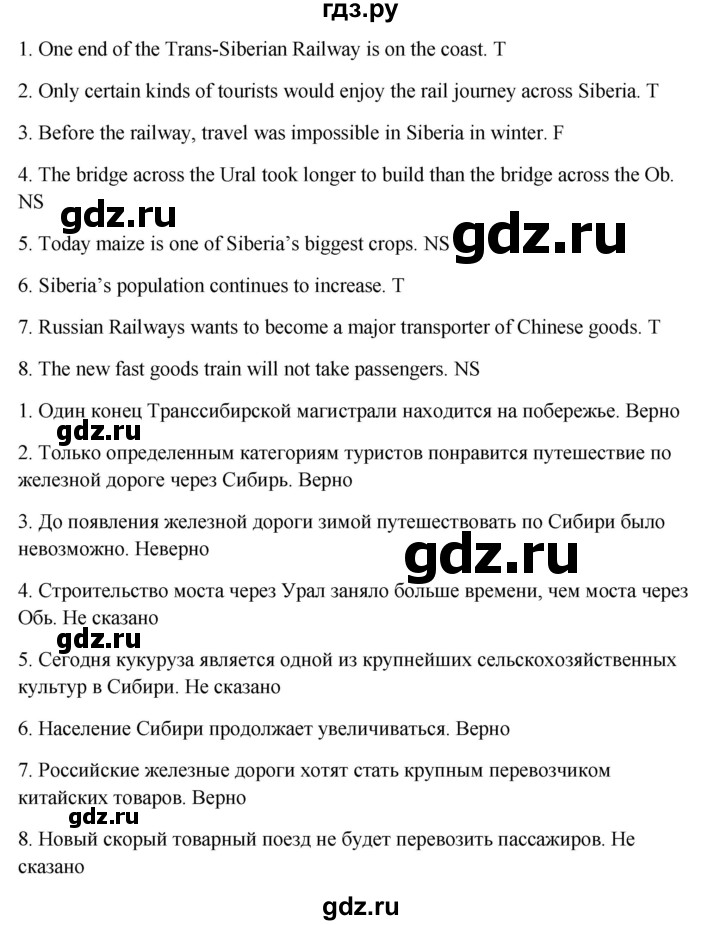
1 One end of the Trans-Siberian Railway is on the coast.
2 Only certain kinds of tourists would enjoy the rail journey across Siberia.
3 Before the railway, travel was impossible in Siberia in winter.
4 The bridge across the Ural took longer to build than the bridge across the Ob.
5 Today maize is one of Siberia's biggest crops.
6 Siberia's population continues to increase.
7 Russian Railways wants to become a major transporter of Chinese goods.
8 The new fast goods train will not take passengers.